
The Use of the AI Assessment Scale in Social Work Assignments
Introduction
Artificial intelligence is rapidly becoming part of everyday life in social work, whether we are ready for it or not. From documentation tools to mental health chatbots to policy analysis platforms, AI is reshaping how we learn, teach, and practice. But for many social workers, especially those early in their education, AI can feel overwhelming, intimidating, or even at odds with the human-centered roots of the profession.
The Artificial Intelligence Assessment Scale (AIAS) developed by Perkins et al. (2024) introduces a systematic framework for instructors to include Generative AI (GenAI) in social work learning assignments for students. It gives educators, students, and practitioners a clear, ethical pathway for using AI without losing our professional identity or our critical thinking skills. Instead of treating AI as all-or-nothing, AIAS offers five intentional levels that help students build foundational knowledge, develop discernment, and learn how to collaborate with technology responsibly.
In this post, we’ll walk through each level of the AIAS framework and show how it can be applied in real social work classrooms—from BSW foundational courses to advanced MSW practice, policy, research, and macro courses. You’ll see examples of assignments, practical guidance for integrating AI into learning, and a vision for what the future of social work education can look like when innovation and ethics work hand-in-hand.
The AI Assessment Scale (AIAS): An Overview
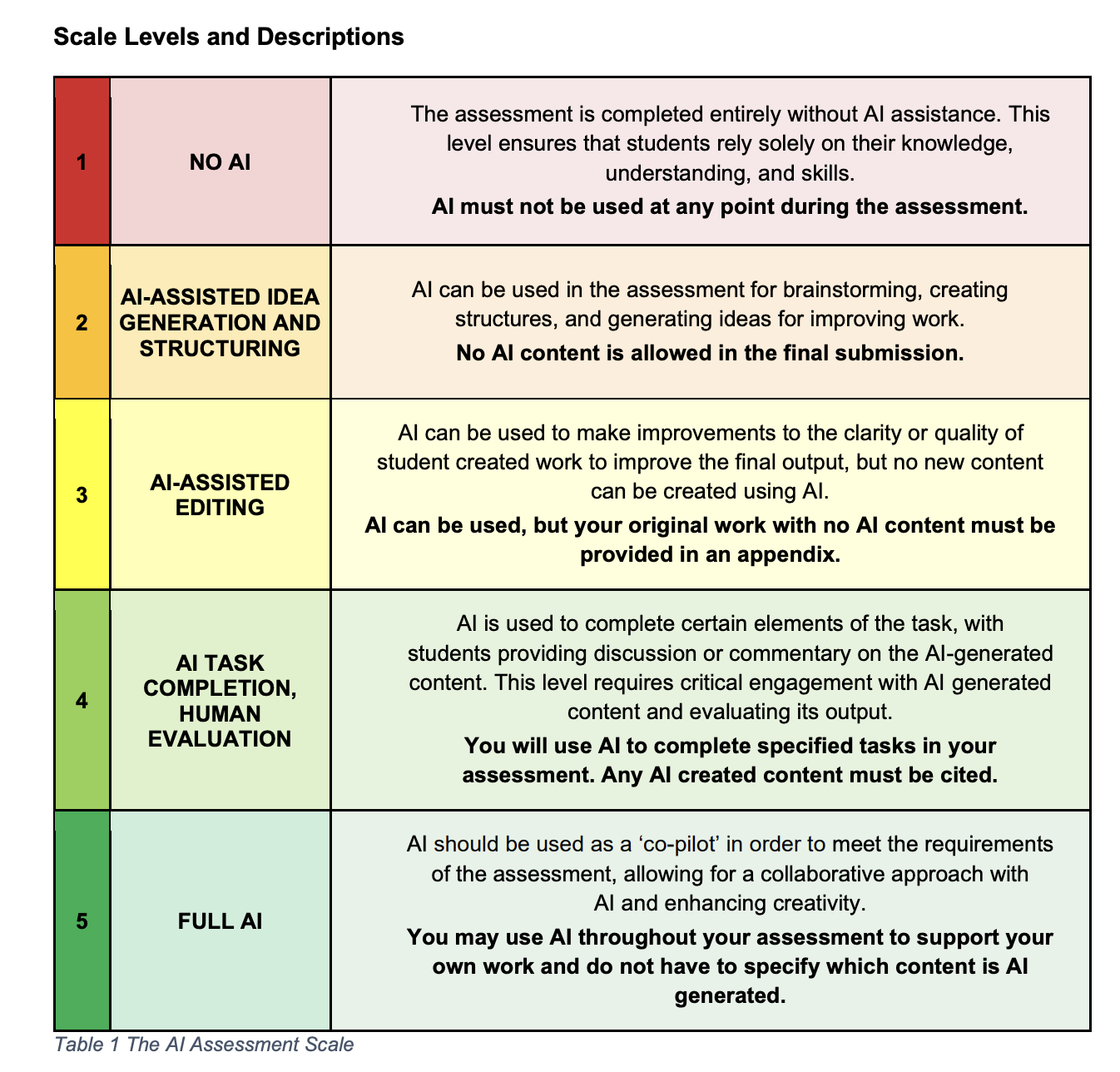
The AIAS framework is intended to assist educators in making appropriate use of GenAI in educational evaluations. The scale is divided into five categories, each indicating a distinct amount of AI integration, ranging from "no AI" to "full AI” (Perkins et al., 2024). This tiered approach enables instructors to design assignments that align with the unique learning objectives of their courses while ensuring that students gain both technical skills and critical thinking abilities.
The AIAS levels are listed below:
Application of AIAS in Social Work Assignments
AIAS is a practical framework you can use as a social work educator to integrate AI ethically, transparently, and intentionally into your classroom. The goal is not to replace critical thinking—but to strengthen it. By offering structured levels of AI use, educators can teach students how to collaborate with AI while maintaining professional responsibility, cultural humility, and ethical decision-making.
AIAS in Social Work Education: Examples Across Levels
Level 1: No AI
This level reinforces foundational social work thinking. Students rely entirely on their own knowledge, course readings, and lived experience.
Example BSW Assignments:
• Case Study Analysis: Students review a narrative of a family in crisis and write an assessment using the ecological model, without any AI support.
• Ethics Scenario: Students respond to an NASW Code of Ethics dilemma and explain their rationale across competing values.
• Identity Reflection: Students write a reflective journal on power, privilege, and intersectionality in their field placement, grounded in their personal experiences.
Example MSW Assignments:
• Complex Ethical Decision-Making Paper: Students analyze boundary issues in clinical practice using two ethical frameworks.
• Policy Critique: Students identify gaps in a state social policy and propose amendments grounded in equity and social justice.
• Research Literacy Assignment: Students identify scholarly articles and write a literature review using their own synthesis.
Why it matters: Students must first build independent reasoning, ethical decision-making, and conceptual understanding before scaling up to AI collaboration.
Level 2: AI-Assisted Idea Generation and Structuring
AI helps students brainstorm, outline, and generate possibilities—but not produce final work.
Example BSW Assignments:
• Program Idea Generator: Students use AI to explore potential after-school program models for youth and choose one to research in depth.
• Interview Prep: AI helps students generate sample interview questions for older adult clients, followed by a reflection on which they used and why.
• Group Project Outlines: AI supports brainstorming steps for a community needs project, but students must finalize all sections themselves.
Example MSW Assignments:
• Intervention Planning: Students use AI to compare multiple evidence-informed interventions for anxiety in adolescents, then select and justify one.
• Research Proposal Drafting: AI helps generate potential research questions; students refine and develop the final proposal independently.
• Clinical Case Conceptualization: AI offers different assessment frameworks (CBT, narrative therapy, etc.), and students critically choose and adapt one.
Why it matters: Students practice discernment—deciding what to accept, reject, or adapt—strengthening their independent professional judgment.
Level 3: AI-Assisted Editing
AI supports language refinement, clarity, formatting, and organization. The student provides both versions.
Example BSW Assignments:
• Client Note Editing: Students write a SOAP note, then use AI to edit for clarity. Both versions are submitted with a reflection.
• Community Flyer: Students design a health resource flyer and use AI to improve readability.
• Discussion Board Response: Students draft a response and use AI for tone adjustments only.
Example MSW Assignments:
• Policy Brief Editing: Students upload a self-written policy memo and use AI to enhance clarity while keeping content intact.
• Clinical Case Report: Students write a narrative summary of a client session, then use AI to refine structure while maintaining their own interpretations.
• Grant Narrative: AI helps improve the cohesion of a student’s grant section, while the content remains entirely the student’s work.
Why it matters: This level teaches students to use AI as a professional writing aide—similar to Grammarly or a writing center—while still owning the content.
Level 4: AI Task Completion, Human Evaluation
AI can generate content, but the student’s job is to critique it. This is where social workers practice evaluating AI, not just using it.
Example BSW Assignments:
• AI-Generated Case Scenario: AI produces a client scenario; students critique missing cultural factors, ethical considerations, or systemic context.
• Role-Play Script: Students evaluate AI’s suggested dialogue for bias or stereotypes and rewrite it.
• Assessment Critique: AI creates an initial assessment; students analyze what is over-generalized or inaccurate.
Example MSW Assignments:
• Data Analysis: AI processes de-identified data (e.g., themes from interviews), and students evaluate whether the themes align with social work principles.
• Safety Plan Evaluation: AI drafts a safety plan, and the student identifies gaps, risks, or ethically problematic elements.
• Policy Scenario Analysis: AI generates a policy implementation plan; students critique feasibility, cultural responsiveness, and equity impacts.
Why it matters: This level develops AI literacy, bias awareness, and professional skepticism—core components of ethical AI use.
Level 5: Full AI Integration
Students use AI throughout the entire assignment cycle and demonstrate their ability to collaborate with technology ethically, responsibly, and strategically.
Example BSW Assignments:
• Community Program Development: AI helps design a small-scale community program; students incorporate cultural responsiveness and anti-oppressive practice.
• Awareness Campaign: Students use AI to generate content, visuals, and messaging for a public awareness initiative on a social justice issue.
• Case Management System: Students use AI tools to build a digital workflow for community referrals.
Example MSW Assignments:
• Comprehensive Needs Assessment: AI helps with data gathering, environmental scans, and literature searches; students synthesize findings.
• Full Program Model: Students develop an AI-integrated program (e.g., digital mental health screening workflow), analyzing risks and safeguards.
• Macro Policy Strategy: AI supports building a legislative advocacy plan; students adapt it through a social justice lens.
Why it matters: Students graduate with the skill set to work in a modern workforce where AI is embedded in documentation, research, planning, and service delivery.

Conclusion
Social work education is entering a period of innovation, and the promise of AI is not about replacing the relational core of the profession. It’s about enhancing it. In the future, social work programs will embed AI literacy. We will see experiential simulations powered by AI, digital field placements that allow students to practice assessments with virtual clients, and coursework that incorporates AI governance, ethics, and policy. Students will be taught to question AI outputs, identify bias, understand data ethics, and develop human-centered AI interventions grounded in social justice. As AI becomes part of agency operations, from triage tools to documentation software, social workers must be ready to lead with strategic foresight. The future of social work education will prepare students not just to use AI, but to shape how AI is used in our field with integrity, equity, and humanity at the center.
The AI Assessment Scale (AIAS) is an effective instrument for incorporating AI into social work education in a planned and deliberate manner. By guiding the use of AI at various levels of engagement, the AIAS guarantees that students have both the technical skills and critical thinking abilities required for modern social work practice. As the industry evolves, the AIAS framework will play an important role in training the next generation of social workers to manage the complexity of a technologically driven professional landscape.
References
Perkins, M., Furze, L., Roe, J., & MacVaugh, J. (2024). The Artificial Intelligence Assessment Scale (AIAS): A framework for ethical integration of generative AI in educational assessment. Journal of University Teaching and Learning Practice, 21(6), 49-66.
The content in this blog was created with the assistance of Artificial Intelligence (AI) and reviewed and edited by Dr. Marina Badillo-Diaz to ensure accuracy, relevance, and integrity. Dr. Badillo-Diaz's expertise and insightful oversight have been incorporated to ensure the content in this blog meets the standards of professional social work practice.